

Illinois forests are home to a wide variety of native trees, shrubs, wildflowers, and wildlife. Unfortunately, they are also increasingly challenged by invasive plant species that can spread rapidly and change the character of a wooded property.
Invasive plants are non-native species capable of establishing and spreading aggressively. In forested areas, they can crowd out native plants, interfere with young-tree regeneration, create dense thickets, and make property management more difficult.
For landowners throughout Illinois, especially those managing woodlots, farms, commercial properties, and undeveloped acreage, recognizing these common invasive plant species is an important first step. Here are some of the invasive species commonly encountered in Illinois forests and wooded areas.
Common Buckthorn
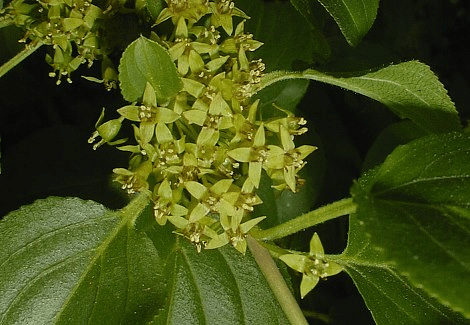
Common buckthorn (Rhamnus cathartica) is one of the most recognizable invasive shrubs in northern Illinois. It commonly grows along woodland edges, fence rows, and beneath mature tree canopies.
Buckthorn often grows as a large shrub or small tree. Its leaves are oval with finely toothed edges, and female plants produce clusters of dark berries. One helpful identification characteristic is that buckthorn frequently stays green later into the fall than many native plants.
The real problem is how densely it grows. Mature buckthorn can create a thick understory that shades native wildflowers, shrubs, and tree seedlings. Birds also eat its berries and distribute the seeds, allowing infestations to expand across a property.
Removing mature plants does not necessarily eliminate an infestation. Cut buckthorn can resprout, and seeds remaining in the soil can produce new seedlings, making follow-up management important.
Invasive Bush Honeysuckle
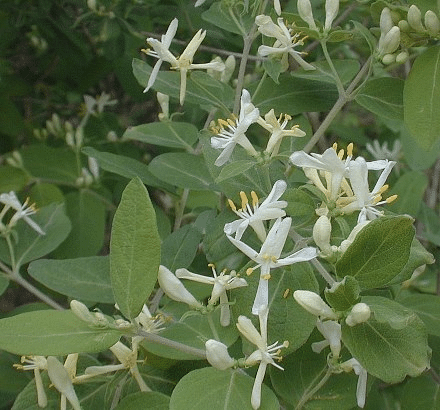
Invasive bush honeysuckles, including Amur honeysuckle, are another common sight in Illinois woodlands.
These shrubs leaf out relatively early and can retain their leaves late into the growing season, giving them a competitive advantage over some native vegetation. Mature plants develop into large, branching shrubs that can form dense colonies beneath trees and along woodland edges.
Depending on the species, bush honeysuckle produces white, yellowish, or pink flowers followed by red berries. Birds spread those berries—and their seeds—to surrounding areas.
Once honeysuckle dominates the understory, native seedlings and ground-layer plants receive less light and growing space. What initially looks like healthy green vegetation can actually indicate a woodland losing plant diversity.
Multiflora Rose
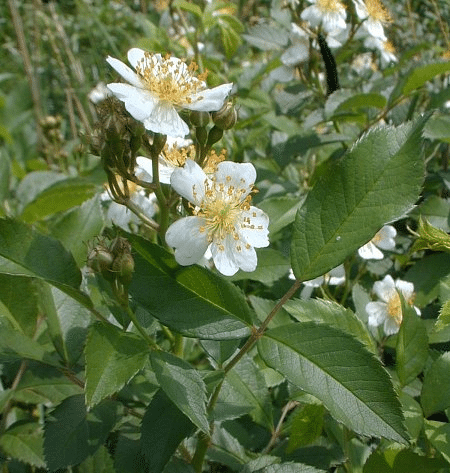
Anyone who has tried walking through a mature patch of multiflora rose knows how quickly this plant can make an area inaccessible.
Multiflora rose produces long, arching stems covered with curved prickles. In late spring and early summer, it develops clusters of small white flowers, followed later by small red fruits called hips.
It can spread through seeds as well as by stems that touch the ground and develop roots. Over time, individual plants can become large, tangled thickets.
Multiflora rose is frequently found along forest edges, pastures, fence lines, roadsides, and disturbed ground. On larger properties, it may become mixed with buckthorn, honeysuckle, vines, and other brush, creating extremely dense vegetation.
Oriental Bittersweet
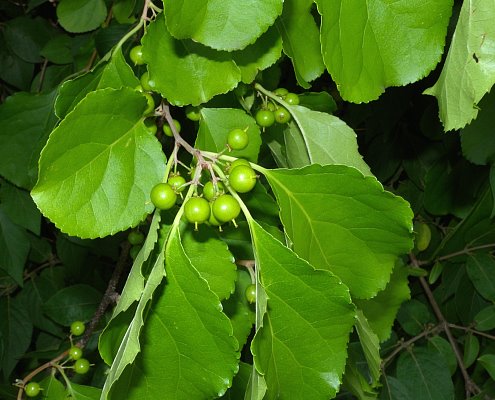
Oriental bittersweet is different from many invasive shrubs because it grows as a woody vine.
The vine climbs trees and other vegetation to reach sunlight. As it grows, it can wrap around trunks and branches and spread through the canopy. Heavy vine growth adds weight to branches and competes with desirable vegetation for sunlight.
Oriental bittersweet is particularly noticeable when its yellow outer fruit capsules open to reveal bright red-orange fruit. Although attractive in appearance, those fruits help spread the plant to new locations.
Property owners should be especially cautious when removing established vines because they can be intertwined high in the canopy of mature trees.
Autumn Olive
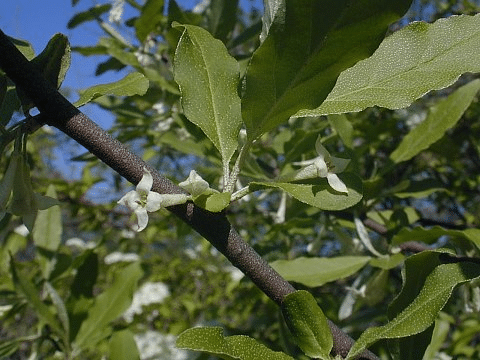
Autumn olive is a large invasive shrub commonly found in open woods, woodland edges, old fields, and disturbed areas.
One of its easiest identifying characteristics is its foliage. The upper surface of the leaf is green, while the underside has a distinctive silvery appearance. The plant produces small, fragrant flowers followed by red fruits with light-colored speckles.
Autumn olive can develop into dense stands and compete with native shrubs and young trees. Birds and other wildlife consume its fruit and spread the seeds, helping the plant establish well beyond the original infestation.
Like other woody invasive species, cutting established autumn olive may result in resprouting, so long-term control often requires more than one visit to the property.
Why Invasive Plant Identification Matters
Not every vine, thorny shrub, or dense patch of vegetation in an Illinois woodland is invasive. Native plants are an important part of healthy forest ecosystems, which is why identifying vegetation before beginning large-scale clearing is important.
Once invasive plants are identified, the appropriate management method depends on the species, infestation size, terrain, desirable vegetation, and long-term plans for the property. Small infestations may sometimes be addressed individually, while acres of established woody vegetation may require mechanical clearing.
For heavily overgrown properties, forestry mulching can be one option for reducing dense above-ground woody vegetation and improving access for future management. Because many invasive plants can resprout or return from seed, forestry mulching should be considered part of an overall vegetation-management strategy rather than a guaranteed one-time solution.
Central Tree, LLC has a separate guide explaining how forestry mulching can help control invasive plant species in Illinois and what property owners should consider when using mechanical clearing as part of an invasive-species management plan.
Managing Overgrown Wooded Property in Illinois
Invasive vegetation becomes considerably harder to manage once individual plants develop into acres of dense brush. Periodically walking wooded property and identifying new growth can help landowners recognize problems before they become large-scale infestations.
Central Tree, LLC provides professional forestry mulching, brush removal, land clearing, tree removal, stump grinding, and site restoration from our headquarters in Pingree Grove, Illinois, serving properties throughout Illinois as well as Southern to Central Wisconsin, Eastern Iowa, and Western Indiana.
If invasive woody vegetation has made your property difficult to access or manage, Request a Free Quote to discuss your land-clearing options, or Stop By Our Location at 14N705 US Highway 20, Pingree Grove, IL 60140.